
Agricultural Production
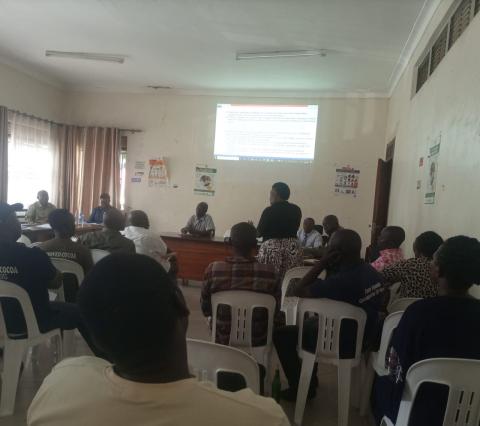
Stakeholders seated during a meeting at Bundibugyo Community Hall to discuss the findings on fertilizers distributed to farmers and measures to protect the district’s organic cocoa certification.
Stakeholders in Bundibugyo District have resolved to ban the use of Bora liquid fertilizers in a move aimed at protecting the district’s internationally recognized organic cocoa certification. The decision followed a research report commissioned to establish the effects of fertilizers that had recently been distributed to farmers across the district.
According to the Bundibugyo District Production Officer, Mr. Light Kisembo Godfrey, the government, through the Production Department under the Smart Agricultural Inputs Programme, distributed different types of fertilizers, including liquid and packaged products, to farmer groups across the district to improve soil fertility and increase cocoa productivity. However, concerns later emerged among farmers, cooperatives, and cocoa-buying companies that some of the fertilizers could compromise the district’s organic status.
Bundibugyo is widely known for producing organic cocoa, a crop that contributes significantly to household incomes and the local economy. Following the concerns raised by stakeholders, district leaders constituted a committee headed by the District Production Officer to investigate the matter and establish the facts.
Presenting the findings, the committee reported that while some of the fertilizers distributed to farmers were acceptable, the liquid fertilizer was not recommended for use in organically certified production systems.
Stakeholders consequently agreed that the supplier should retrieve the liquid fertilizers from farmers. The meeting further resolved that Fert Plus should remain the recommended fertilizer for use in Bundibugyo because of its organic certification credentials, although it should not be applied in liquid form.
Meanwhile, farmers have been urged to strengthen household food production as a strategy for combating poverty and food insecurity. The call was made by the Bundibugyo Deputy Resident District Commissioner, Ms. Marysent Ariyo, during the closure of the stakeholders’ meeting. She expressed concern that many households rely heavily on purchasing food and encouraged residents to grow crops such as bananas on their homesteads to improve food security and reduce expenditure.
Ms. Ariyo also challenged residents to embrace government development programmes aimed at improving livelihoods and boosting agricultural production.
The District Chairperson, Mr. Tibakunirwa Robert, welcomed the committee’s findings, describing them as an eye-opener for stakeholders in the cocoa sector. He called for increased advocacy and promotion of cocoa, noting that despite its importance to the local economy, the crop is still not receiving the national recognition it deserves. He cited a recent meeting convened by the Minister of Agriculture in which several cash crops were highlighted, but cocoa was reportedly not mentioned.
The resolutions are expected to strengthen efforts to safeguard Bundibugyo’s organic cocoa industry while promoting sustainable farming practices and household food security across the district.